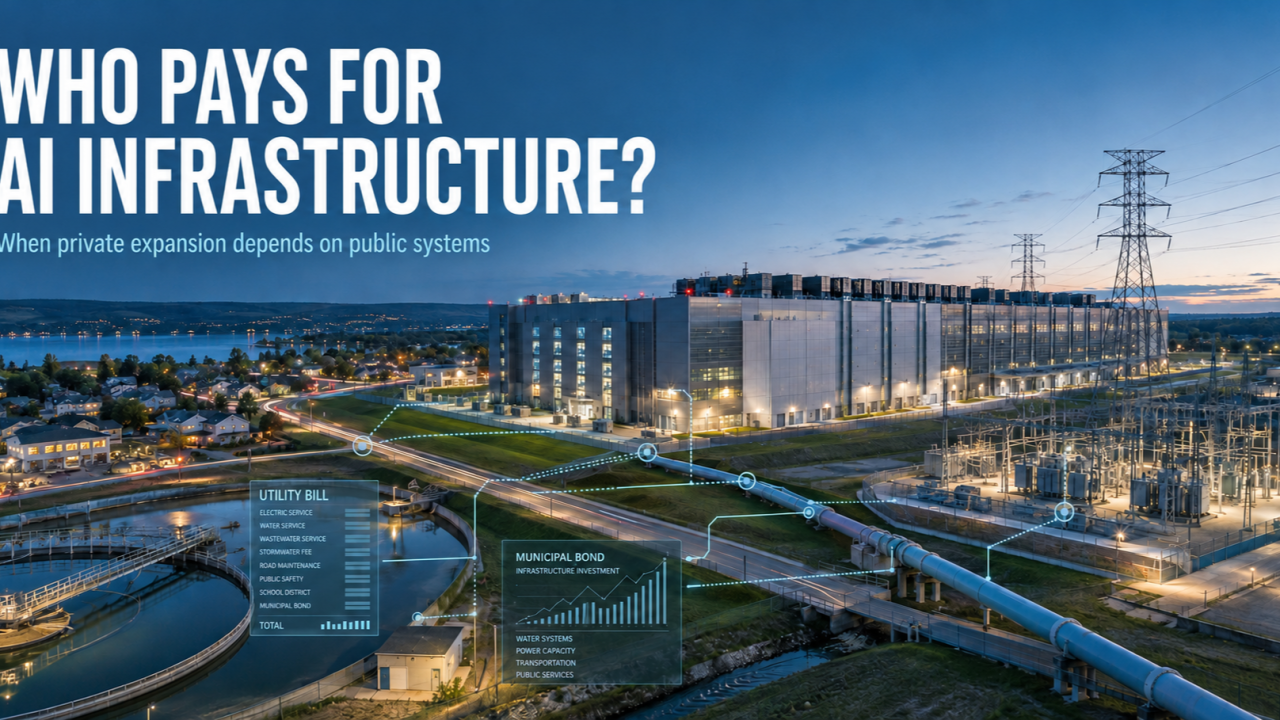
The data-center boom is presented as private investment. But when power plants, transmission lines, water systems, roads and long-term capacity commitments are built around it, the financial risk does not always remain private.
The central question is not whether communities should welcome data centers. It is whether each project carries the full cost and risk of the infrastructure it causes.
Private capital, public balance sheet
A hyperscale or AI data center can represent billions of dollars in private investment. It can expand a locality’s tax base, support a surge of construction employment and create well-paid technical positions. Those are real benefits, and communities should not dismiss them.
But a data center is not a self-contained building. It is a permanent claim on interconnected systems: generation, transmission, substations, water supply, wastewater treatment, roads, land and emergency services. Some of those assets may be privately financed. Others are built by regulated utilities, public authorities or local governments and recovered over decades through tariffs, taxes, debt or foregone revenue.
That is where the phrase “private investment” becomes incomplete. The building may be private while part of the enabling infrastructure—and much of the downside risk—sits on a public or regulated balance sheet.
The scale has changed the financial question
Berkeley Lab’s 2026 update estimates that U.S. data centers could consume 11.8 percent of national electricity by 2030 in its reference case, with a modeled range of 9.5 to 15.3 percent. That is not ordinary incremental growth. It is a potential reordering of power-system planning, compressed into only a few years.
Utilities must plan before the demand fully exists. They may need to secure generation, transmission rights, substations, transformers and fuel capacity years in advance. Yet AI demand forecasts remain uncertain, projects are announced faster than they are completed, customers may ramp more slowly than contracted, and computing efficiency or business strategy can change.
The risk is therefore temporal as well as financial: infrastructure must be committed today for loads that may arrive later, arrive partially or move elsewhere. If ordinary customers guarantee the recovery of those investments while the large customer retains flexibility, the public has effectively written a one-sided option.
Five ways the risk can migrate to the community
- Grid expansion. Transmission lines, substations and new generation can enter the utility rate base. Unless costs are directly assigned and backed by durable contracts, households and existing businesses may share the bill for capacity created by a handful of very large users.
- Water and wastewater. New mains, treatment capacity, pumping, storage and discharge systems can require public financing. Even when a facility’s direct consumption is moderate, peak demand, redundancy and local scarcity can force system upgrades or reduce capacity available for future housing and industry.
- Roads, land and public services. Construction traffic, road reinforcement, intersections, emergency response and land-use changes impose costs before long-term revenue is proven.
- Tax incentives and foregone revenue. Sales-tax exemptions, property-tax reductions, grants and fee waivers are expenditures by another name. They can be justified only when measured against incremental—not headline—jobs, revenue and infrastructure obligations.
- Environmental and capacity liabilities. Noise, emissions, watershed impacts and land conversion may not appear in a project’s financing model, but they affect property, health, resilience and the community’s future development choices.
Virginia shows both sides of the ledger
Virginia’s Joint Legislative Audit and Review Commission offers one of the clearest public assessments. It found substantial economic benefits and local tax revenue, but emphasized that much of the economic impact occurs during construction. A typical 250,000-square-foot facility may support about 50 full-time workers, while roughly 1,500 workers may be on site at the peak of its 12- to 18-month construction period.
The same review found that Virginia’s sales-and-use-tax exemption delivered an estimated $928 million in tax savings to data centers in fiscal year 2023. It also concluded that unconstrained state electricity demand could double within ten years, driven principally by data centers, and that meeting even half of that demand would be difficult.
This does not prove that the industry costs Virginia more than it contributes. It proves something more important: the answer depends on location, tax structure, infrastructure requirements, contract protections and the time horizon used. Gross investment is not the same as net public value.
Regulators are beginning to price the stranded-asset risk
The most revealing policy response is appearing in utility regulation. In January 2025, Georgia regulators authorized special terms for new customers above 100 megawatts. The rule allows recovery of site-specific and upstream generation, transmission and distribution costs, extends contracts from five to fifteen years and permits minimum billing requirements. The stated purpose is explicit: a large customer should not leave before paying for infrastructure built for it.
Virginia followed with a separate rate class for customers demanding at least 25 megawatts, effective in 2027. Certain large customers must pay at least 85 percent of contracted transmission and distribution demand and 60 percent of generation demand. These measures are not hostility toward technology. They are basic project-finance discipline applied to regulated infrastructure.
A fair community bargain
Communities should not choose between unconditional approval and blanket rejection. They should require a financeable, transparent bargain in which benefits and liabilities are assigned before construction begins.
- Cost causation: The project pays for the incremental grid, water, wastewater, road and emergency-service capacity it requires.
- Durable commitments: Take-or-pay contracts, minimum bills, security deposits, parent guarantees or letters of credit protect against delayed ramp-up, cancellation and early exit.
- No speculative socialization: Generation or network investment should not enter the general rate base merely because a queue of nonbinding projects suggests future demand.
- Lifecycle accounting: Incentives are evaluated against permanent employment, verified tax revenue, infrastructure depreciation, environmental mitigation and closure risk—not only construction spending.
- Resource-resilient design: Closed-loop cooling, reclaimed water, alternative supply, storage, flexible load, onsite generation and demand management reduce the capacity that the host community must guarantee.
- Public disclosure: Residents should see the assumptions behind demand, water, incentives, cost recovery and contingency plans, subject to legitimate commercial confidentiality.
Resilience belongs in the capital stack
The cheapest project on paper may be the one that externalizes the most risk: onto ratepayers, municipal water systems, taxpayers or the next generation of local development. A more resilient project may carry higher upfront capital costs but impose lower system costs and less political risk over its operating life.
That changes how resilient infrastructure should be understood. Water reuse, closed-loop cooling, alternative water supply, distributed energy, storage and flexible operations are not decorative sustainability features. Where they reduce peak demand, avoid public upgrades or protect scarce local capacity, they are financial risk controls. They should be evaluated alongside land, servers and power contracts—not added after permitting controversy begins.
The same logic should matter to lenders and investors. A project dependent on subsidized tariffs, uncertain water allocations, contested transmission or uncompensated community impacts may appear cheaper, but it is not necessarily more bankable. Social license and infrastructure adequacy are becoming credit variables.
The real question
AI infrastructure will be built because its economic and strategic value is substantial. The issue is not whether society should invest. The issue is whether the public is asked to absorb risks that sophisticated private counterparties are unwilling to carry themselves.
A credible data-center proposal should be able to answer, in plain language: What new infrastructure is required? Who finances it? Who owns it? Who pays if demand arrives late? Who pays if the facility closes early? What capacity remains for residents and other businesses? What environmental liabilities survive the project? And what guarantees make those answers enforceable?
If those questions are unresolved, the community is not merely hosting AI infrastructure. It may be underwriting it.
- Lawrence Berkeley National Laboratory, United States Data Center Energy Usage Report: 2025 Update (published June 2026)
- Virginia Joint Legislative Audit and Review Commission, Data Centers in Virginia (2024)
- Georgia Public Service Commission, new power-usage terms for data centers (January 23, 2025)
- Virginia State Corporation Commission, new large-scale energy-user rate class (November 25, 2025)