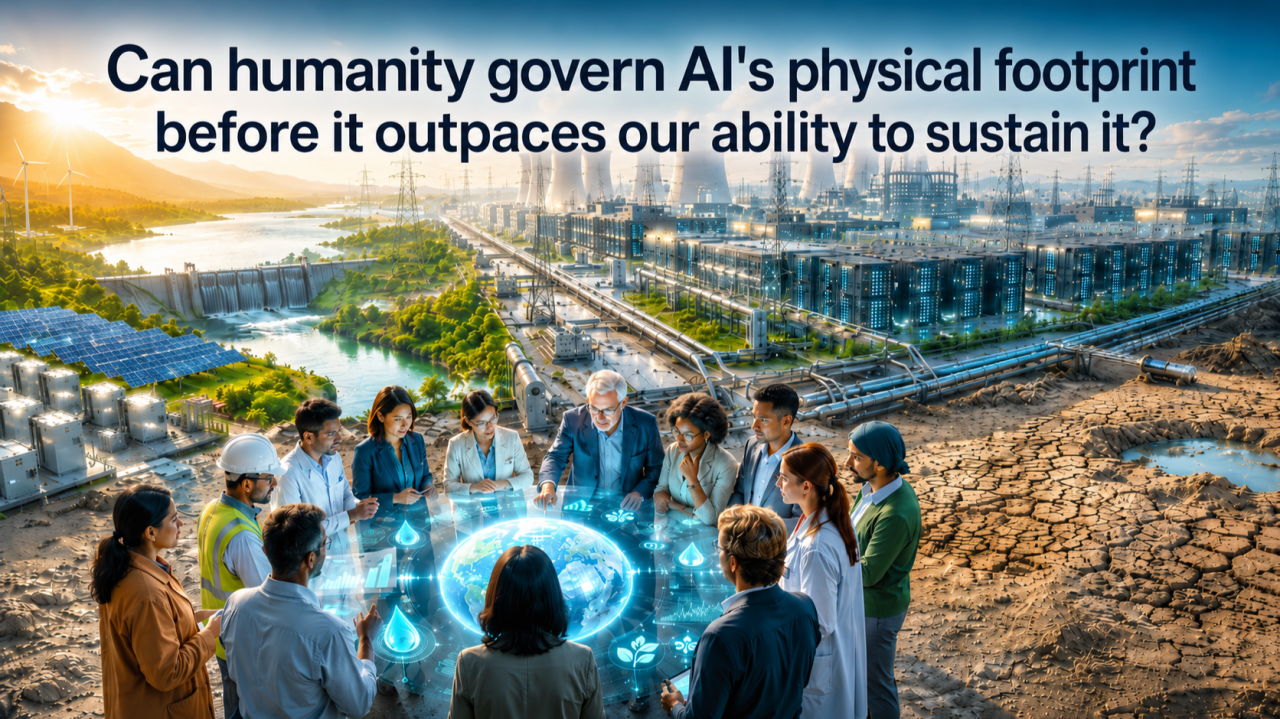
Artificial Intelligence is rapidly becoming one of humanity’s most powerful tools. It is helping scientists predict extreme weather events, optimize renewable energy systems, improve water management, accelerate medical research, and increase industrial efficiency. Many believe AI could become one of the most important technologies in the fight against climate change.
Yet behind every AI model, every chatbot interaction, every image generation request, and every autonomous decision system lies a physical infrastructure that consumes vast amounts of energy, water, land, and raw materials.
The challenge facing society today is not whether AI can help solve global problems. The challenge is whether humanity can deploy AI at a scale that remains compatible with planetary boundaries.
The AI Perspective: A Powerful Climate Tool
From a technological perspective, AI offers unprecedented opportunities. The International Energy Agency estimates that AI-driven optimization could significantly improve energy efficiency across buildings, transportation systems, industrial processes, and power grids. AI is already helping utilities forecast electricity demand, manage renewable energy variability, reduce transmission losses, and improve grid reliability.
In the water sector, AI is being used to detect leaks, forecast drought conditions, optimize treatment plants, improve irrigation efficiency, and monitor watershed health. These applications have the potential to reduce resource consumption and increase resilience in a world increasingly affected by climate change.
In theory, AI could become one of the most effective tools humanity has ever developed for managing scarce resources.
The Human Perspective: Every Digital Decision Has a Physical Cost
What is often overlooked is that AI is not a virtual technology. It is a physical infrastructure industry.
Large AI models operate in hyperscale data centers that require enormous quantities of electricity and water for processing and cooling. The growth trajectory is staggering.
Recent studies estimate that data centers could consume nearly 1,000 terawatt-hours (TWh) of electricity annually by 2030—equivalent to the current annual electricity consumption of Japan. Some projections suggest AI-related workloads alone could account for 3% to 4% of global electricity demand within the next decade.
Water demand is becoming equally significant. Research estimates that AI and data center operations could consume hundreds of billions of gallons of freshwater annually. One widely cited projection estimates global AI-related water consumption could exceed 264 billion gallons per year by 2027.
To put this into perspective:
- 264 billion gallons equals approximately 1 trillion liters of water.
- This volume could supply more than 13 million people with drinking water for an entire year.
- It is roughly equivalent to the annual municipal water consumption of a large metropolitan region.
These numbers are not necessarily catastrophic in a global context. Agriculture still consumes approximately 70% of global freshwater withdrawals.
The concern is concentration. Water withdrawals occur locally, while sustainability reports are often presented globally. A data center may represent a small fraction of worldwide water use while simultaneously becoming one of the largest industrial water consumers within a specific watershed.
The Transparency Problem
The growing debate surrounding AI infrastructure is not only about resource consumption. It is about measurement.
Many technology companies publish sustainability reports describing:
- Water consumption
- Carbon emissions
- Renewable energy procurement
- Resource efficiency metrics
These disclosures are valuable. However, communities increasingly ask a more fundamental question: How do we know?
A claim of “100% renewable energy” based on Renewable Energy Certificates (RECs) is not necessarily the same as operating on renewable electricity in real time. A water consumption estimate derived from engineering assumptions is not necessarily the same as continuously measured facility-level withdrawals.
Transparency is not merely the publication of numbers. Transparency is confidence in the numbers.
As AI infrastructure expands, society will increasingly require independently verified environmental performance rather than solely company-generated sustainability reporting.
What Happens if the Balance Is Lost?
History provides numerous examples of technologies that delivered enormous benefits while generating unintended consequences. Fossil fuels enabled industrial development but accelerated climate change. Plastics transformed modern life but created a global pollution crisis.
The same risk exists with AI.
If the balance between technological progress and environmental stewardship is not maintained, several consequences could emerge.
Water Stress Intensifies
In regions already facing drought conditions, additional industrial demand could accelerate aquifer depletion and increase competition among municipalities, agriculture, and industry. The United Nations estimates that by 2030 global freshwater demand could exceed sustainable supply by as much as 40%. Adding large-scale AI infrastructure without corresponding water resilience strategies could worsen this imbalance.
Energy Infrastructure Faces New Pressure
If AI-related electricity demand reaches projected levels, utilities may need to deploy hundreds of gigawatts of additional generation capacity worldwide. Without rapid expansion of renewable energy, storage, and grid modernization, increased demand could delay decarbonization efforts and increase dependence on fossil-fuel generation.
Social License Becomes a Critical Risk
Communities are increasingly questioning whether scarce water and energy resources should be prioritized for AI facilities while residents face rising utility costs, water restrictions, or aging infrastructure. Without trust and transparency, opposition to new data center developments is likely to grow. More than sixty local jurisdictions in the United States have already implemented restrictions, moratoriums, or additional review requirements for data center development.
AI Becomes a Victim of Its Own Success
Ironically, the greatest risk may be that AI growth becomes constrained by the very resources it requires.
The future bottleneck may not be computing power.
It may be water.
It may be electricity.
It may be community acceptance.
The Path Forward: Water-Positive and Energy-Resilient AI
The solution is not to slow innovation. The solution is to align innovation with sustainability. The next generation of AI infrastructure must move beyond traditional sustainability reporting toward measurable outcomes:
- Real-time environmental monitoring.
- Independent verification of water and energy claims.
- Water-positive operations.
- Wastewater reuse and recycling.
- Renewable-powered facilities with energy storage.
- Circular resource management strategies.
- Transparent community engagement.
The most successful AI infrastructure operators of the future will not simply build the largest models. They will build the most resilient ecosystems around those models.
A New Definition of Intelligence
Perhaps the most important question facing society is not whether AI is intelligent. The question is whether humanity will be intelligent enough to govern it responsibly.
Artificial Intelligence may help solve many of the world’s most pressing challenges. But if the environmental costs remain opaque, unmanaged, or disconnected from the communities that bear them, AI risks becoming another example of a technology that solved one problem while creating another.
The future belongs not merely to Artificial Intelligence. It belongs to Sustainable Intelligence—where innovation, water security, energy resilience, and community well-being advance together.
The balance is still within reach. The decisions made during this decade will determine whether we keep it.