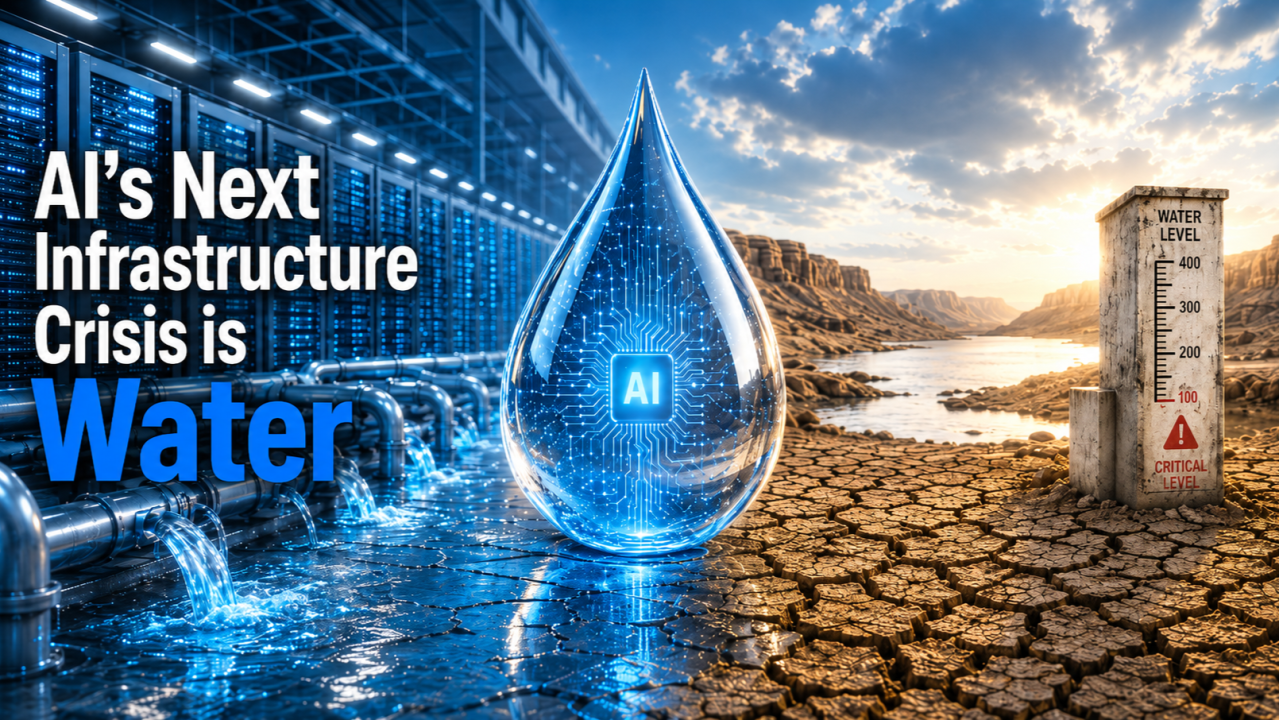
The race to build AI infrastructure is usually described as an electricity problem. Data centers need vast amounts of power, new transmission capacity, backup generation, and faster permitting.
But May 2026 made something else clear: the next bottleneck may be water.
Across the U.S. and abroad, communities are beginning to ask a simple question: why should scarce local water be used to cool data centers when residents, farms, wetlands, and cities are already under drought pressure? That question is no longer theoretical.
On May 21, Utah declared a statewide drought emergency after its warmest winter on record and its lowest snowpack levels ever recorded. All 29 counties were in severe drought, and 22 were in extreme drought. Just days later, Drought.gov reported that 50.77% of the U.S. and Puerto Rico, and 60.77% of the Lower 48 states, were in drought as of May 26.
A New Wave of Resistance
That is the backdrop for a new wave of resistance to data-center growth.
In Coachella, California, hundreds of residents protested Stronghold Power Systems’ proposed Coachella Valley Technology Campus, a project that could span 450 acres and include up to six data centers. The city council moved toward a possible moratorium after residents raised concerns about water use, energy demand, air pollution, extreme heat, and proximity to homes and schools.
The same conflict is unfolding internationally. In Quilicura, outside Santiago, Chile, data-center growth is colliding with a 15-year mega-drought. The area has 33 operating data centers and 34 more planned, while residents and activists warn that wetlands are drying and water use remains too opaque.
In India, Google’s planned $15 billion AI hub in Visakhapatnam has drawn scrutiny because the region already faces water stress. Reporting on the project describes government incentives, including discounted land and water, while local communities worry about displacement and shortages.
The pattern is becoming hard to ignore. AI infrastructure is moving faster than public trust.
The Public Acceptance Problem
For years, data centers were treated as clean, quiet economic development projects. They promised investment, digital modernization, and jobs. But AI has changed the scale. Larger computing loads create more heat. More heat requires more cooling. And in many facilities, cooling still depends on large volumes of water.
That creates a public acceptance problem.
A project can have the power contract, the land, and the political support, but still face opposition if the community believes it is being asked to sacrifice water security for remote corporate gain. Erin Brockovich’s new U.S. AI data-center impact map, which compiles more than 2,700 community reports across 49 states, shows how organized this concern is becoming.
This does not mean data centers should not be built. AI infrastructure is becoming part of the modern economy. The question is whether it can be built in a way that communities can accept.
Building With Resilience
That means water can no longer be an afterthought. It has to be part of site selection, permitting, design, and public communication from the beginning.
The winning projects will be those that can prove three things: they reduce freshwater demand, they are transparent about water use, and they strengthen local resilience instead of competing with it.
That is where decentralized and low-water infrastructure becomes strategically important. Technologies such as closed-loop cooling, wastewater reuse, rainwater capture, groundwater monitoring, and onsite water generation can shift the conversation from extraction to resilience. India’s government has already pointed to high-tech cooling approaches such as direct-to-chip liquid cooling, immersion cooling, adiabatic cooling, wastewater reuse, and groundwater monitoring as part of the response to rising concern over AI data-center water demand.
For companies working at the intersection of water, energy, and infrastructure, the message is clear. The AI boom does not only need more chips, power, and land. It needs water systems that can survive drought, reduce local conflict, and earn public trust.
"In the next phase of AI infrastructure, water will not be a side issue. It will be a deciding factor."