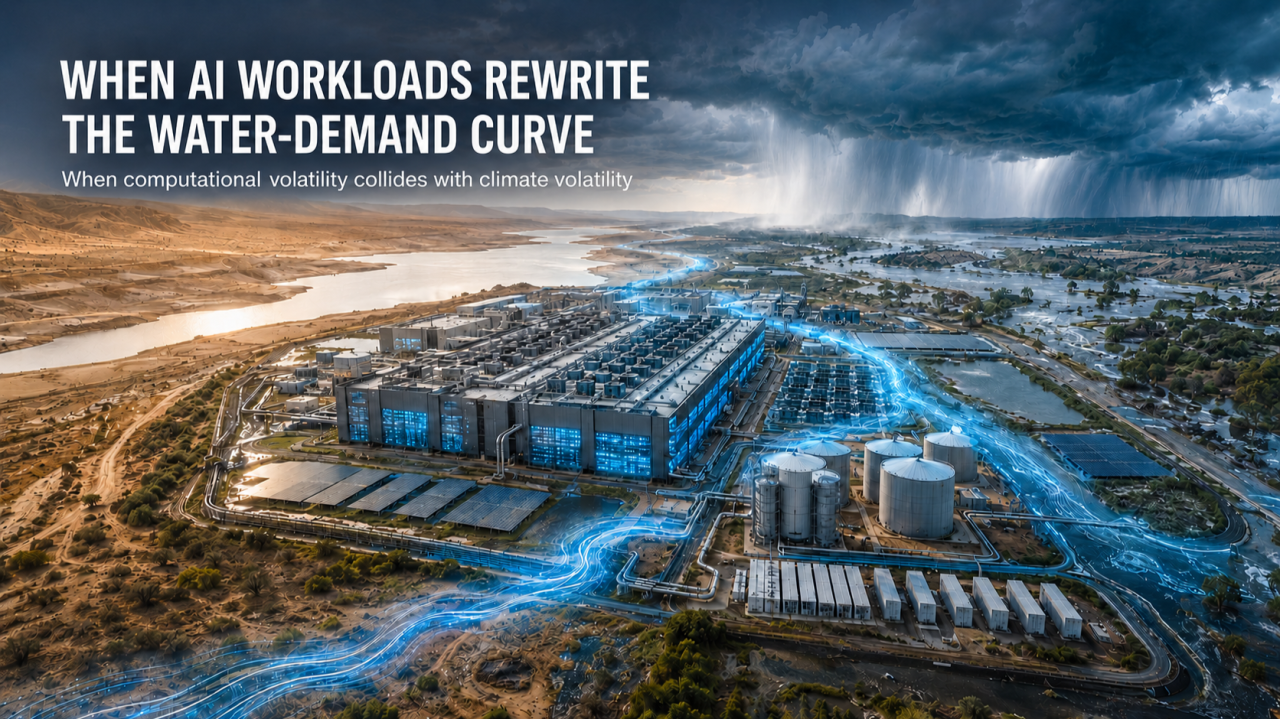
What happens when computational volatility collides with climate volatility? For decades, water utilities have planned demand around relatively familiar variables: population growth, industrial development, seasonal temperatures, rainfall patterns and historical peak consumption. Artificial intelligence is introducing a new variable—one that water planners cannot see and may not even know they need to measure: computational workload.
AI data centers do not simply consume a fixed amount of electricity and water every day. Their heat generation changes according to the type, intensity and timing of the computing taking place inside them. Large model-training runs can create sustained, energy-intensive loads. Inference workloads can fluctuate with user activity, query complexity and real-time events.
Nearly every unit of electricity entering computing equipment ultimately becomes heat that must be removed. That makes computational demand a potential driver of cooling demand—and, depending on the facility’s design, water consumption. Now this emerging operational volatility is colliding with an increasingly volatile climate.
El Niño changes the risk calculation
In August 2026, the U.S. National Oceanic and Atmospheric Administration reported that El Niño was strengthening, with a greater than 90% probability of becoming a very strong event during the Northern Hemisphere fall and winter of 2026–27. The World Meteorological Organization has warned of above-normal temperatures across much of the world, accompanied by a familiar but geographically uneven El Niño footprint: drought and heatwaves in some regions, excessive rainfall and flooding in others.
These forecasts do not mean that every data-center market will become hotter or drier. El Niño affects regions differently, and seasonal outcomes remain probabilistic. But for data centers and the communities hosting them, it introduces another layer of uncertainty into infrastructure systems that are already under pressure.
The same workload can have a very different water footprint
A 2025 peer-reviewed review led by Lawrence Berkeley National Laboratory found that water consumption per data-center workload can vary by more than 10,000-fold. That extraordinary range is shaped by server efficiency, utilization, cooling technology, local climate, facility performance and the water intensity of the electricity grid.
A workload processed by efficient equipment in a cool location, using closed-loop cooling and low-water electricity, can have a radically different footprint from the same workload processed by older equipment in a hot, water-stressed region dependent on evaporative cooling and water-intensive power generation.
El Niño may widen those differences. Higher ambient temperatures reduce the hours during which facilities can rely on outside air or other economization strategies. Chillers, cooling towers and adiabatic systems may have to operate longer and harder. The critical issue is not only how much water a data center consumes annually. It is how much water it may require on the hottest and most constrained day.
The “small bottle, big pipe” problem
A data center may represent a modest percentage of statewide annual water use while requiring a municipality to reserve millions of gallons of treatment, pumping, storage, distribution and wastewater capacity every day. This is the “small bottle, big pipe” problem: annual consumption may appear manageable, but the infrastructure must be built for the peak.
Those peaks become more consequential when they coincide with drought restrictions, residential demand, agricultural irrigation, wildfire response and maximum electricity use.
Flooding does not automatically mean water security
El Niño also exposes a misconception that deserves greater attention: more rainfall does not necessarily mean greater water availability. A region can experience flooding and water insecurity simultaneously. Extreme rainfall can increase turbidity, overwhelm wastewater systems, contaminate source water, damage pumping infrastructure and force reservoir releases. Unless that water can be captured, treated, stored and distributed, a dramatic rainfall event does not provide dependable industrial supply.
From water efficiency to water resilience
The response cannot be limited to asking data centers to consume fewer liters per kilowatt-hour. Efficiency is essential, but efficiency alone does not ensure resilience when total computing demand continues to expand.
A climate-resilient data center should be designed as an integrated compute–energy–water system. The objective should be to separate computational peaks from community water peaks—not allow the two to collide.
The central question is no longer simply: How much water does AI consume? It is: What happens when computational volatility, extreme heat, drought, electricity demand and community water needs converge on the same infrastructure at the same time?
The next generation of digital infrastructure should not arrive as an unpredictable new burden on public systems. It should bring its own resilience: dependable water, distributed energy, storage, intelligent management and the ability to operate without compromising the communities that host it.