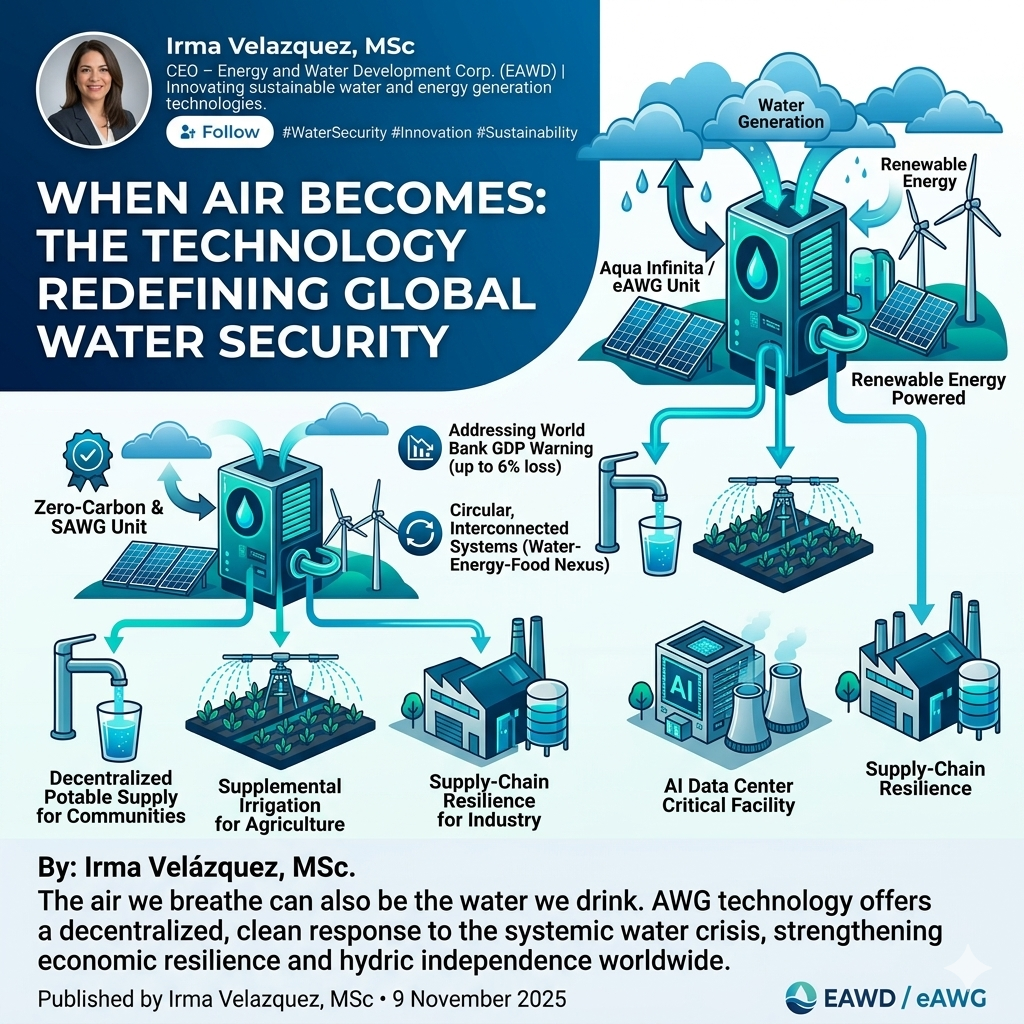
The latest World Bank report on the global water crisis arrives with a stark warning: water —that silent but vital resource— is becoming a defining factor of economic growth.
According to the report, water scarcity, exacerbated by climate change and poor management, could cut up to 6% of GDP in entire regions over the coming decades if urgent measures are not taken.
The document emphasizes that it’s no longer enough to build more dams or drill deeper wells. The crisis is systemic, affecting the interconnected pillars of modern development: water, energy, food, and climate. This raises a crucial question: how do we innovate beyond traditional water management methods?
Atmospheric Water Generation: A Technology That Breathes Solutions
Atmospheric Water Generation (AWG) —the process of extracting water from ambient air through controlled condensation— is emerging as a powerful tool to complement global water security strategies.
Instead of relying on depleted aquifers or costly transport systems, AWG proposes a decentralized, clean, and self-sufficient model capable of producing potable water right where it is needed.
From rural communities to industrial sites, this technology aligns directly with the World Bank’s recommendations to diversify water sources, strengthen resilience, and accelerate technological innovation in water infrastructure.
From Economic Warning to Technological Opportunity
The World Bank identifies three priority fronts where innovation can make a tangible difference:
- Efficiency and smarter water allocation. Water must flow toward higher-value social and economic uses. AWG provides independent supplemental supply, relieving pressure on critical sources like rivers and aquifers.
- Resilient infrastructure. The Bank calls for systems capable of withstanding droughts, power shortages, and extreme weather events. AWG systems —being modular, scalable, and renewable-powered— fit precisely within this framework.
- Diversification and private-sector engagement. The report urges financial mechanisms that attract investment and speed up innovation. Service-based models such as “Water as a Service” powered by AWG open new opportunities for public–private collaboration in sustainable water delivery.
The Future Equation: Water + Energy + Innovation
The synergy between water generation and renewable energy is central. When powered by solar or wind, AWG systems become zero-carbon, fully autonomous units adaptable to multiple scales —from industrial plants to micro-installations for communities or individual households.
This integration echoes the World Bank’s “Water–Energy–Food Nexus” approach, where water security depends on circular, interconnected systems that reduce environmental impact while increasing local independence.
Real-World Applications: From Cities to Fields
- Urban areas under stress: AWG units can ensure potable water for hospitals, schools, and public buildings without overloading municipal grids.
- Agriculture: In high-evaporation regions, AWG can supplement irrigation for high-value crops, easing aquifer depletion.
- Tourism and islands: Resorts and coastal developments can reduce transported water costs and improve sustainability.
- Industry: Sectors such as food, pharmaceuticals, and semiconductors are already adopting AWG to strengthen supply-chain resilience amid water restrictions.
A Call to Action
The World Bank’s report is unequivocal: without smarter water management, global economic growth will suffer. Yet it also opens the door to innovation —to solutions that integrate technology, sustainability, and resilience.
Atmospheric Water Generation is not science fiction; it’s a tangible response to a global challenge. Each liter produced from air represents a step toward hydric independence, offering governments, companies, and communities a new tool to secure their future.
The air we breathe can also be the water we drink. And in a world where the next global crisis may well be one of water, innovation is no longer optional —it’s an imperative.