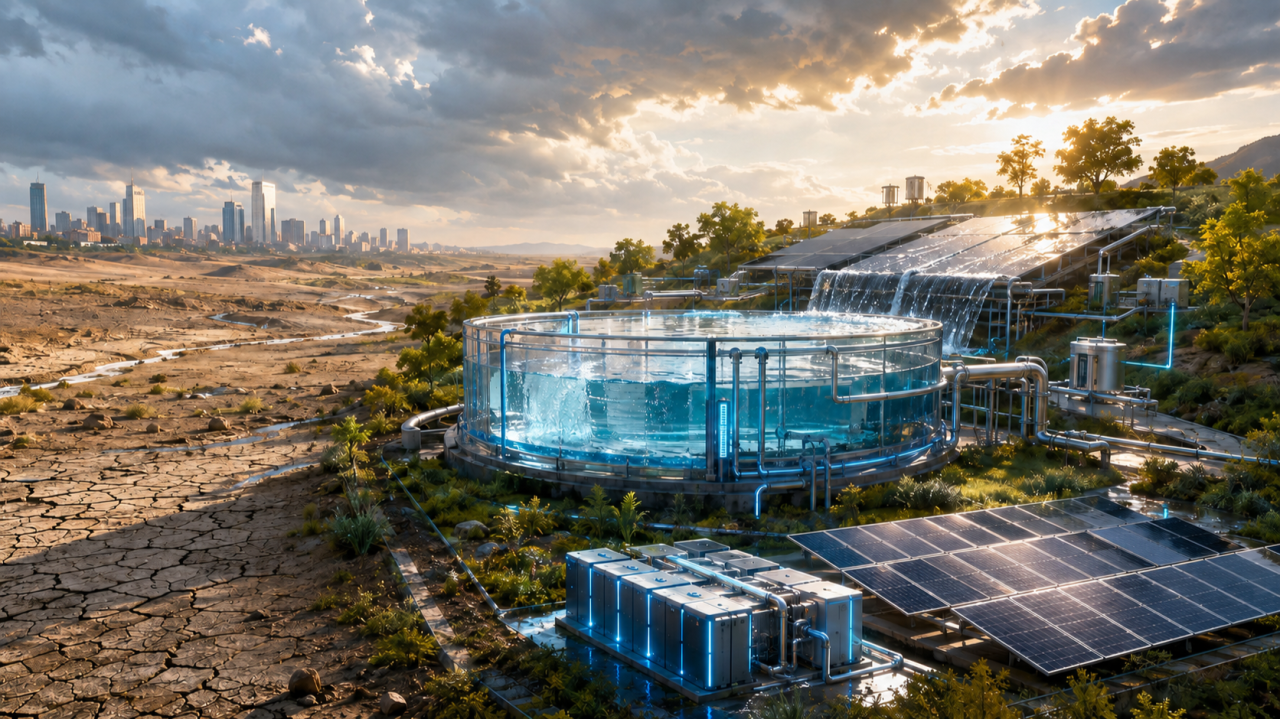
Why the next generation of resilient infrastructure must store water as deliberately as it stores energy.
For decades, water security has largely been treated as a question of supply: Where can more water be found? Which new source can be developed? How can a larger volume be transported to where demand is growing?
But in an era of increasing climate volatility, access to a source is only part of the answer.
Water may be available during a period of intense rainfall and unavailable several weeks later. A municipal network may function normally until drought, contamination, an electricity outage, infrastructure failure, or a sudden surge in demand interrupts service. A facility may be located near an abundant supply and still lack reliable access at the moment it is needed most. This reveals a fundamental distinction that infrastructure planning has too often overlooked:
Water availability is not the same as water security.
True water security depends on the ability to capture, treat, store, monitor, and deliver water across changing conditions. Without storage, even a technically viable water source can remain operationally unreliable.
An increasingly unpredictable water cycle
The global water cycle is no longer behaving within the ranges on which much of today’s infrastructure was designed.
The World Meteorological Organization’s State of Global Water Resources 2024 describes a water cycle becoming increasingly erratic and extreme, with sharp departures from normal conditions across rivers, reservoirs, lakes, groundwater, and glaciers. In 2024, severe flooding affected parts of Africa, Europe, and Asia, while serious drought persisted across areas of South America and southern Africa.
These are not separate water problems. They are different expressions of the same growing instability: water arriving in the wrong quantity, at the wrong time, or in the wrong place.
At the same time, the planet is losing some of its most important natural buffers. According to the World Bank, natural water storage in soils, wetlands, aquifers, glaciers, and snowpack has declined by approximately 27 trillion cubic metres over the past five decades. UN-Water also reports that terrestrial water storage—including soil moisture, snow, and ice—has been declining at an estimated rate of one centimetre per year over the past two decades.
The consequence is not simply “less water.” It is less capacity to absorb periods of abundance and bridge periods of scarcity.
The overlooked storage gap
The World Bank has described freshwater storage as being at the heart of climate adaptation because it allows societies to save water for drier periods while reducing the effects of floods. Yet the storage challenge is often reduced to a discussion about building more dams or larger reservoirs.
Those systems remain important, but the storage infrastructure of the future must be more diversified.
Water can be stored naturally in aquifers, soils, wetlands, and watersheds; centrally in reservoirs and municipal systems; and locally in tanks, cisterns, treatment loops, and other on-site infrastructure. Each layer serves a different function. Together, they can create resilience that no single source or structure can provide alone. This matters because centralized networks were generally built to deliver water under expected conditions—not necessarily to guarantee continuity through prolonged drought, extreme heat, grid failures, contamination events, rapid population growth, or the concentrated demand of new industrial facilities.
The question, therefore, is no longer only how much water a system can produce or transport annually. It is also:
- How long can essential operations continue if the primary supply is interrupted?
- Can water produced or collected during favorable conditions be preserved for later use?
- Is stored water continuously monitored for quantity and quality?
- Can different sources be combined without compromising safety or reliability?
- Can the system prioritize critical uses when supply becomes constrained?
These are questions of resilience, not simply capacity.
Energy learned this lesson earlier
The energy sector offers a useful comparison. Solar and wind generation became substantially more valuable when paired with storage, because electricity could then be retained and dispatched when production and demand did not coincide. Batteries transformed intermittent generation into a more controllable resource and created new possibilities for backup power, peak management, and off-grid operation.
Water infrastructure requires a similar change in thinking.
A decentralized water source without adequate storage may produce water but still fail to ensure continuity. Rainwater capture without storage loses much of its value between rainfall events. Recycled water without appropriate separation, treatment, and management may not be available for the application that needs it. Even atmospheric water generation becomes more resilient when production can occur during favorable temperature, humidity, and energy conditions and the resulting water can be safely stored for later demand.
Storage changes the operating model. It separates the moment when water becomes available from the moment when it must be consumed. That flexibility is becoming indispensable.
From passive tanks to intelligent water reserves
Storage should not mean placing a tank beside a building and assuming the problem has been solved.
A resilient water reserve must be appropriately sized and connected to treatment, pumping, energy, controls, and monitoring. Operators need visibility into water levels, production rates, consumption patterns, quality indicators, and the remaining period of autonomy. The system should identify losses, abnormal demand, declining quality, or mechanical problems before they become emergencies.
Intelligent management can also determine when water should be generated, treated, transferred, conserved, or released. When combined with weather information and demand forecasting, storage becomes an active operating asset rather than a passive container.
This is particularly important for facilities whose water needs cannot simply stop: hospitals, hotels, food producers, farms, communities, manufacturing plants, emergency-response sites, and data centres. For them, a water interruption is not an inconvenience. It can become a health, safety, financial, or operational crisis.
Storing water and energy together
Water and energy resilience are inseparable.
Water systems require energy for generation, treatment, pumping, cooling, monitoring, and distribution. Energy systems often depend on water for cooling, processing, equipment cleaning, fuel production, or the operation of supporting facilities. Designing one system without considering the other creates hidden points of failure.
An on-site water reserve cannot provide full resilience if pumps and treatment equipment stop during an electricity outage. Likewise, an energy-resilient facility remains vulnerable if its water supply fails.
This is why the next generation of decentralized infrastructure should integrate:
- multiple context-appropriate water sources;
- treatment and reuse;
- appropriately sized water storage;
- renewable or distributed energy generation;
- battery energy storage; and
- intelligent monitoring and resource management.
The objective is not necessarily complete isolation from public infrastructure. In many cases, the strongest model will be a hybrid one: remaining connected to municipal water and the electrical grid while developing enough on-site capacity to reduce demand, manage costs, and maintain critical operations during disruption.
A new measure of water security
For governments, developers, companies, and investors, annual water availability is no longer an adequate measure of resilience.
A better measure is autonomy: how long a community, building, farm, or industrial operation can safely continue when its conventional supply is constrained.
That requires planners to consider not only average consumption, but peak demand, critical loads, seasonal conditions, source reliability, treatment capacity, storage volume, water quality, and the energy required to keep the entire system functioning.
At Aqua Infinita, we believe that resilient infrastructure must be designed around this integrated reality. Water should be generated or recovered from the sources best suited to each location, stored for the conditions in which it will be needed, and managed together with the energy that makes the system operate.
The future of water security will not be defined only by finding more water. It will be defined by how intelligently we preserve, manage, and deploy every available drop.
Because water without storage is still water at risk.