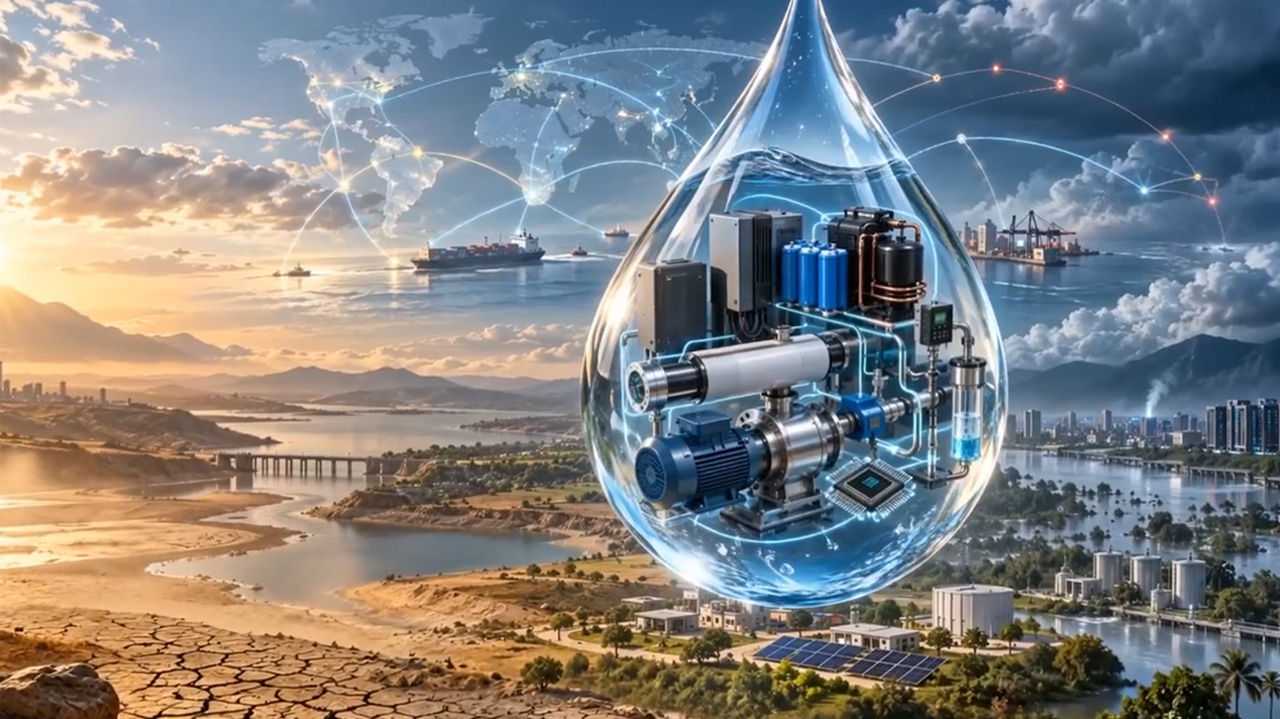
As a potentially very strong El Niño develops, climate volatility is meeting a world of export controls, concentrated manufacturing and strained infrastructure. The result is a new vulnerability: the systems needed to secure water may themselves be difficult to obtain, replace or operate.
Somewhere in the tropical Pacific, the ocean is warming. Thousands of kilometres away, reservoir managers, farmers, power utilities, manufacturers and governments are watching.
They have reason to pay attention. On 10 September, the US National Oceanic and Atmospheric Administration reported that El Niño was strengthening, with a greater than 90 percent chance of becoming a very strong event during the Northern Hemisphere fall and winter of 2026–27.
El Niño does not produce the same outcome everywhere. It can bring drought to one region and extreme rainfall to another. Its importance lies in how it redistributes risk across water, agriculture, electricity, transport and public health. This time, that volatility is arriving in a world already marked by persistent water stress, record energy demand, rapid data-centre expansion and increasingly fragmented trade.
The central question is therefore larger than the next seasonal forecast: what happens when demand for resilient water infrastructure rises just as the supply chains needed to build it become less dependable?
A Fourth Era of Infrastructure
Modern water planning has passed through several overlapping eras. The first emphasized expansion: dams, reservoirs, pipelines and centralized treatment. The second placed greater weight on efficiency, public health and environmental regulation. The third added decarbonization, digital controls and the integration of renewable energy.
We are now entering a fourth era. Its defining requirement is continuity under conditions of climate volatility and geopolitical fragmentation. In this era, the question is no longer only whether a technology can produce or treat water efficiently. Decision-makers must also ask whether its essential components can be delivered, legally procured, digitally trusted, serviced and replaced throughout the life of the asset.
El Niño as a Real Time Stress Test
It would be inaccurate to reduce El Niño to a simple equation in which warming Pacific waters cause drought everywhere. Hydrological effects are geographically uneven and shaped by local climate, soil, reservoirs, groundwater and previous conditions.
Yet this unevenness does not make the risk smaller. It makes planning more complex. One region may face reservoir decline and reduced hydropower. Another may experience flooding that damages roads, ports or production facilities. Agricultural demand may rise while electricity supply weakens. Public agencies and private operators may compete for the same equipment and emergency capacity.
The danger is not only the severity of a single event. It is the possibility that disruptions across several sectors and regions overlap.
That overlap matters because water systems depend on energy, transport, chemicals, digital controls and specialized equipment. A reservoir can be full while a treatment plant lacks a critical chemical. A desalination unit can be installed while its inverter is delayed. A water generator can be mechanically sound while a failed compressor or controller has no available replacement.
The Hidden Supply Chains Inside Water Resilience
A desalination plant, wastewater-reuse system, atmospheric water generator or decentralized water platform may be assembled in North America, Europe, the Middle East or Asia. Its upstream dependencies may be much more concentrated than the final product suggests.
The International Energy Agency reported that global lithium-ion battery manufacturing capacity exceeded 4 terawatt-hours by the end of 2025, with more than 80 percent located in China. China also accounted for about 85 percent of cathode active material production and more than 90 percent of anode active material production.
Those figures matter far beyond electric vehicles. Batteries increasingly support pumping, treatment, atmospheric water generation, desalination, remote monitoring and emergency water systems. Local pack assembly does not automatically produce a locally resilient supply chain if cells, active materials or production equipment remain concentrated elsewhere.
Inverters present another underappreciated dependency. They sit between solar generation, batteries, pumps and controls. Their availability matters, but so does their admissibility. Cybersecurity concerns and procurement restrictions increasingly influence which digitally connected equipment can be used in government, critical-infrastructure and security-sensitive projects.
The relevant question is no longer simply whether a component exists. It is whether the component can be financed, imported, certified, connected and trusted in the intended application.
Atmospheric Water Generation Has Upstream Exposure Too
Atmospheric water generation is often discussed as if it were a stand-alone water technology. In practice, many systems draw on the wider refrigeration and heat-pump ecosystem: compressors, evaporators, condensers, fans, sensors, refrigerants, motors and power electronics.
The IEA has identified rotary compressors as a highly concentrated upstream segment, with production predominantly located in China. This does not mean that every atmospheric water generator uses a Chinese compressor, or that every compressor presents the same risk. It means that AWG manufacturers participate in a broader component market where a disruption can travel across brands and countries.
This distinction is important. Resilience cannot be assessed from the logo on the enclosure. It requires knowledge of the components inside it, their origin, the availability of substitutes and the time required to replace them.
The Decentralization Paradox
Decentralized water systems promise to reduce dependence on distant reservoirs, long pipelines and vulnerable centralized networks. They can produce, treat, reuse or store water closer to the point of demand. When paired with local energy and intelligent controls, they can protect critical operations during disruption.
But there is a paradox. We are trying to decentralize water while relying on some of the world’s most concentrated manufacturing ecosystems to do it.
Ignoring that contradiction does not make decentralized systems less valuable. It tells us how they must be designed. A resilient platform needs more than distributed equipment. It needs supply-chain visibility, interchangeable architecture, regional service capability and control over the digital systems on which it depends.
What Resilience Now Requires
The answer is not autarky. No country or company can efficiently manufacture every membrane, battery cell, compressor, motor, sensor and chemical it needs. Attempting to eliminate international dependence altogether would increase costs and could slow the deployment of urgently needed infrastructure.
The practical objective is to prevent a single supplier, country, route, digital vulnerability or regulated component from becoming an avoidable point of failure.
That requires a different discipline:
- Map critical dependencies beyond the final equipment manufacturer, including selected upstream components.
- Qualify more than one supplier or an engineered substitute for components that can stop water production.
- Design modular interfaces so replacements do not require rebuilding an entire system.
- Maintain strategic stocks of high-impact parts and treatment inputs, guided by failure rates, shelf life and replacement lead time.
- Use regional integration, testing, training and service centres to shorten recovery time.
- Include export controls, cybersecurity, logistics disruption and substitution rights in procurement and project contracts.
- Update climate assumptions throughout the project life rather than treating historical averages as permanent conditions.
Water Security Has Become Industrial Security
For much of the modern era, water security was treated as a local resource and utility question. That boundary no longer holds.
A climate-driven water shortage can reduce hydropower, interrupt manufacturing, constrain agriculture or disrupt transport. A mineral export restriction can delay motors, batteries or power electronics needed for adaptation. A cyber rule can make an available inverter unacceptable for a critical project. A chemical shortage can stop a functioning treatment plant.
Water security is therefore becoming inseparable from energy security, trade security, digital security and industrial capacity.
The world will not build resilience by withdrawing from cooperation. The task is to preserve those gains without confusing efficiency with security.
Real resilience does not require independence from the world. It requires freedom from any one avoidable point of failure. That is the defining infrastructure challenge of the fourth era.
Source Notes
- NOAA Climate Prediction Center. ENSO Diagnostic Discussion and strength probabilities issued 10 September 2026.
- World Meteorological Organization. El Niño and global seasonal climate updates.
- International Energy Agency. Global EV Outlook 2026 Electric vehicle batteries.
- International Energy Agency. Global EV Outlook 2026 Manufacturing and trade.
- International Energy Agency. Energy Technology Perspectives 2026 Supply chain risks and industrial competitiveness.
- International Energy Agency. Heat Pump Monitor 2026 Key findings.
- International Energy Agency. Critical minerals supply concentration and export controls.
- United States Environmental Protection Agency. Water Treatment Chemical Supply Chain Profiles.
Editorial note: The article distinguishes global supply-chain evidence from product-specific claims. Atmospheric water generation exposure must be verified by manufacturer and model; climate outlooks are probabilistic and regional effects vary.