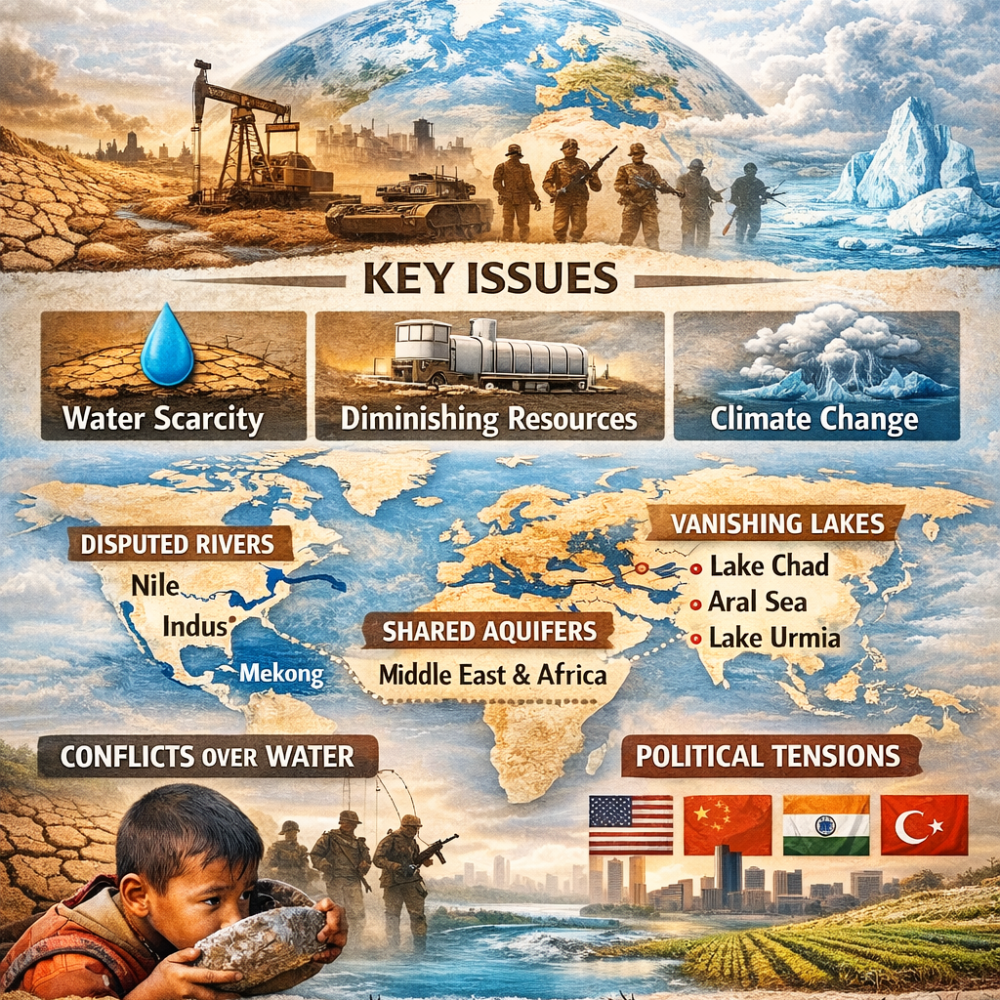
The global geopolitical landscape is undergoing a profound transformation, driven not only by energy, technology, and security concerns, but increasingly by water.
According to the recent “Continental Drying” report by the World Bank, large portions of the world are entering a new hydrological era characterized by persistent droughts, declining soil moisture, shrinking surface water, and overexploited aquifers.
This shift is no longer a future risk—it is a present geopolitical reality.
From Climate Risk to Geopolitical Risk
Historically, water scarcity was treated as an environmental or developmental challenge. Today, it has become a strategic variable shaping national security, economic resilience, migration patterns, and regional stability.
The World Bank’s findings show that entire continents—particularly parts of Latin America, Africa, the Middle East, Southern Europe, and Asia—are experiencing long-term drying trends that directly threaten food systems, urban water supply, and industrial productivity.
Water stress now behaves much like energy insecurity: nations that control reliable water sources gain leverage, while those dependent on fragile hydrological systems face rising vulnerability. This imbalance is already influencing diplomatic relations, trade negotiations, and internal political stability.
Water as the New Strategic Asset
In many regions, water is quietly replacing oil as the most critical resource. Transboundary rivers, shared aquifers, and climate-exposed basins are becoming pressure points for cooperation—or conflict.
Countries upstream gain strategic advantage, while downstream nations face existential risks to agriculture and population centers.
The Continental Drying report highlights that economic losses from water scarcity could reach 6% of GDP in some regions by mid-century. Such losses amplify social inequality, fuel displacement, and strain governments—conditions that historically precede political instability.
Implications for Global Markets and Development
For investors, governments, and corporations, the message is clear: water security is now economic security.
Industries such as agriculture, tourism, semiconductors, data centers, mining, and energy generation are increasingly constrained not by demand, but by access to reliable water.
This is accelerating a shift toward:
- Decentralized water production
- Climate-resilient infrastructure
- Water-as-a-Service (WaaS) models
- Technologies that decouple water supply from rainfall and aquifers
Just as renewable energy reshaped geopolitics by reducing dependence on fossil fuels, new water technologies are beginning to reshape power dynamics by reducing dependence on rivers, dams, and groundwater.
A Turning Point for Policy and Innovation
The World Bank’s warning is not only diagnostic—it is strategic. It signals a turning point where governments must integrate water resilience into national security strategies, urban planning, and economic policy. Solutions will require a mix of governance reform, regional cooperation, and rapid deployment of innovative water systems.
In this new geopolitical era, water is no longer a background issue. It is a front-line determinant of stability, competitiveness, and sovereignty.
The Water-Geopolitics Nexus
In conclusion, the age of “continental drying” marks a shift in how power is defined and protected. Nations that anticipate this transition—by securing diversified, climate-independent water supplies—will gain resilience and strategic advantage. Those that do not risk falling into a cycle of scarcity, economic decline, and instability.
Water, once taken for granted, has become one of the most decisive geopolitical forces of the 21st century.