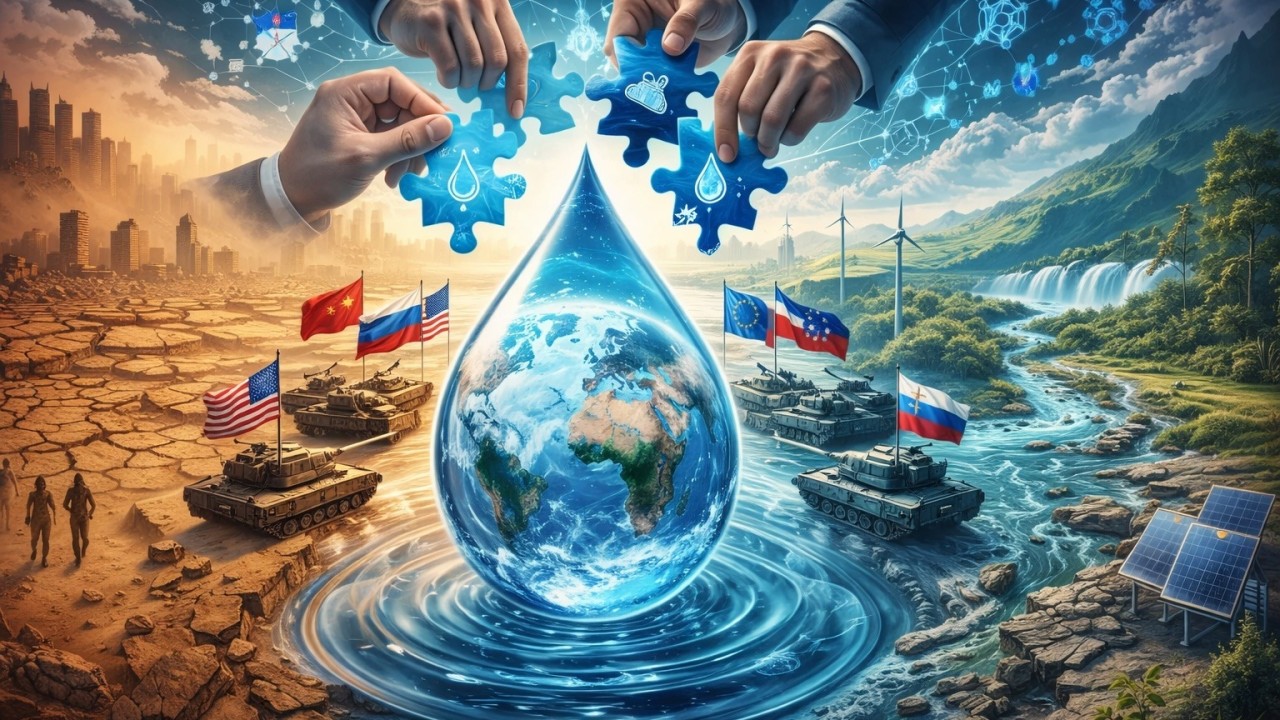
Water has quietly become one of the most strategic resources of the 21st century. Not because the planet is running out of water in absolute terms—but because accessible, reliable, and clean freshwater is becoming unevenly distributed, increasingly politicized, and deeply entangled with climate change, food security, energy systems, and migration.
With more than 300 transboundary river basins crossing political borders, the question is no longer academic:
Can global water cooperation realistically exist in today’s geopolitical landscape?
The honest answer: Yes—but not in the way we traditionally imagine it.
Why a single "global water governance system" is unrealistic
In today’s world, water is treated much like energy or critical minerals: as an issue of sovereignty, security, and economic survival. Three realities make a fully centralized global water framework unlikely:
- 1. Water equals leverage Upstream countries control flows; downstream countries absorb risk. This structural imbalance makes states reluctant to yield authority over water decisions.
- 2. Geopolitics has shifted from cooperation to competition The multilateral optimism of the 1990s has given way to fragmented blocs, sanctions, and security-first policies. Even climate agreements struggle under these dynamics—water is no exception.
- 3. Water crises are deeply local Glacier melt, aquifer depletion, pollution, failing infrastructure, and population growth vary widely by region. A single global policy tool cannot address such diverse realities.
Where cooperation is actually happening
Despite these constraints, water cooperation is not failing—it is evolving.
- Basin-level and regional agreements: The most effective cooperation occurs at the scale of river basins and aquifers. Quiet, technical agreements on allocation, flood control, and data-sharing often work better than highly politicized global treaties.
- Data and risk-sharing without sovereignty loss: Countries are increasingly willing to cooperate on hydrological monitoring, early-warning systems for floods and droughts, and water-quality standards. These forms of cooperation reduce risk without threatening national control.
- Finance as a catalyst: Development banks and climate funds increasingly link financing to cooperation, transparency, and resilience. This aligns national interest with collective outcomes—often more effectively than diplomacy alone.
- Technology as neutral ground: Decentralized and climate-resilient solutions—water reuse, efficiency, renewable-powered desalination, and atmospheric water generation—reduce dependence on shared water sources. Less dependency often means less conflict.
The Uncomfortable Truth
- Water wars are rare. Water stress is constant. Water rarely causes wars directly, but it accelerates instability, migration, food insecurity, and social unrest.
- Moral arguments don’t drive policy—risk does. Governments act when water scarcity threatens economic growth, political legitimacy, or national security.
- The Global South bears the highest exposure. Not just because of climate impacts, but due to infrastructure gaps, financing constraints, and governance limitations.
What “Global Water Cooperation” will really look like
Not a single authority. Not one treaty. But a patchwork system:
- Regional compacts
- Shared data platforms
- Climate-linked financing
- Technology transfer
- Emergency water diplomacy during shocks
In short: coordination, not centralization.
Final reflection
Global water cooperation is possible—but only if we abandon romanticized visions of universal governance.
Water is following the same path energy already has: from abundance → scarcity → securitization → decentralization → cooperation by necessity.
The countries, cities, and companies that recognize this shift early—and invest in resilient, decentralized water strategies—will not only adapt to the water crisis. They will shape the geopolitical landscape that follows.
Water is no longer just a resource. It is strategy.