President Trump’s visit to China will be covered, predictably, as a trade story. There were the usual summit deliverables: tentative investment understandings, agricultural talks, aircraft discussions, and proposals for new trade and investment boards. But that misses the deeper point.
The real message from Beijing was not about soybeans, airplanes, or diplomatic choreography. It was about capacity.
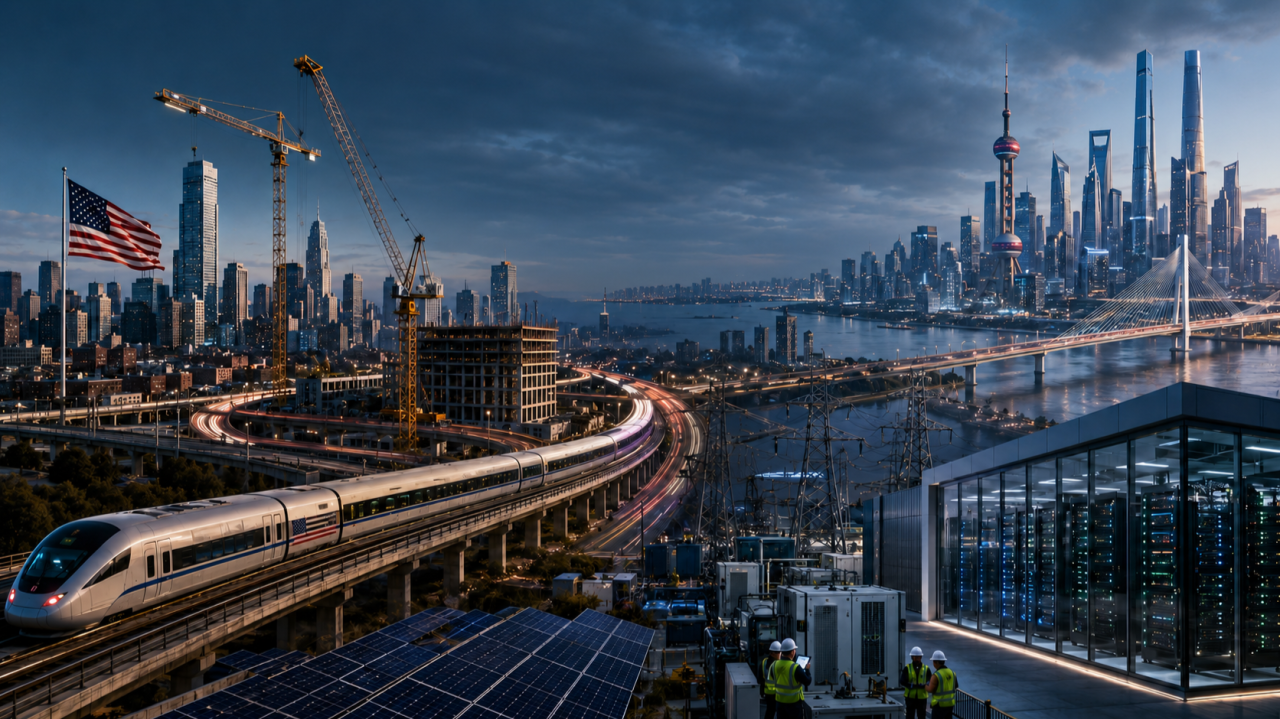
China has spent decades building the physical systems that make national power real: rail, ports, factories, power grids, housing, digital networks, charging stations, and industrial zones. These are not separate projects. They are one operating system.
The United States still tends to treat infrastructure as a local inconvenience. A bridge is a bridge. A road is a road. A rail corridor is a fight over cost, zoning, lawsuits, and whose district gets what.
China treats infrastructure as strategy. That difference matters.
The Ecosystem Approach vs. The Pothole Approach
China’s high-speed rail network now stretches beyond 50,000 kilometers. The United States still does not have a comparable national passenger rail system. China has built the world’s largest electric vehicle charging network. America is still debating how to modernize roads, rails, ports, and power lines while trying to close a multitrillion-dollar infrastructure gap.
To be clear, the United States does not need to become China. It should not copy China’s political model, its surveillance state, or its top-down approach to public life. But America does need to recover the habit of building seriously.
- Faster approvals for national value projects: Transmission lines, freight rail, ports, water systems, semiconductor corridors, and advanced manufacturing zones. Stop letting uncertainty become a veto.
- Modernizing the grid: The next economy runs on electricity: data centers, artificial intelligence, electric vehicles, heat pumps, factories, robotics, and advanced manufacturing.
- Durable financing: Major projects need financing that survives election cycles. A permanent infrastructure bank, or something like it, would give the country a way to plan over decades instead of budget windows.
Infrastructure is Industrial Policy
The larger lesson is that infrastructure and industrial policy cannot be separated. China does not build charging stations, ports, batteries, and rail lines as isolated assets. It builds ecosystems. If America wants to lead in chips, aerospace, clean energy, artificial intelligence, electric vehicles, and robotics, it needs the physical foundation those industries require: reliable power, modern freight systems, skilled labor, ready-to-build sites, and ports that can move goods efficiently.
None of this works without public trust.
Americans are skeptical of big projects for good reason. Too many come with cost overruns, weak oversight, political favoritism, and timelines that drift into absurdity. The answer is not to stop building. The answer is to build with more discipline: public budgets, clear milestones, independent audits, and consequences when managers fail.
The True Contest of Power
The U.S.-China competition is often described in terms of tariffs, technology, military power, or diplomatic influence. Those all matter. But underneath them is a simpler contest.
Who can build faster? Who can move goods faster? Who can power the next economy? Who can connect workers, factories, ports, data centers, and markets into a functioning national system?
China has made infrastructure central to its power. America still has enormous advantages: deep capital markets, world-class universities, abundant energy, innovative companies, and a political culture that rewards experimentation. But those strengths are weakened when ports clog, power lines lag, rail projects stall, and basic construction takes a decade to approve.
The lesson from Beijing is not that America should imitate China. It is that America should become a more serious version of itself.
Great powers do not just negotiate strength. They build it.