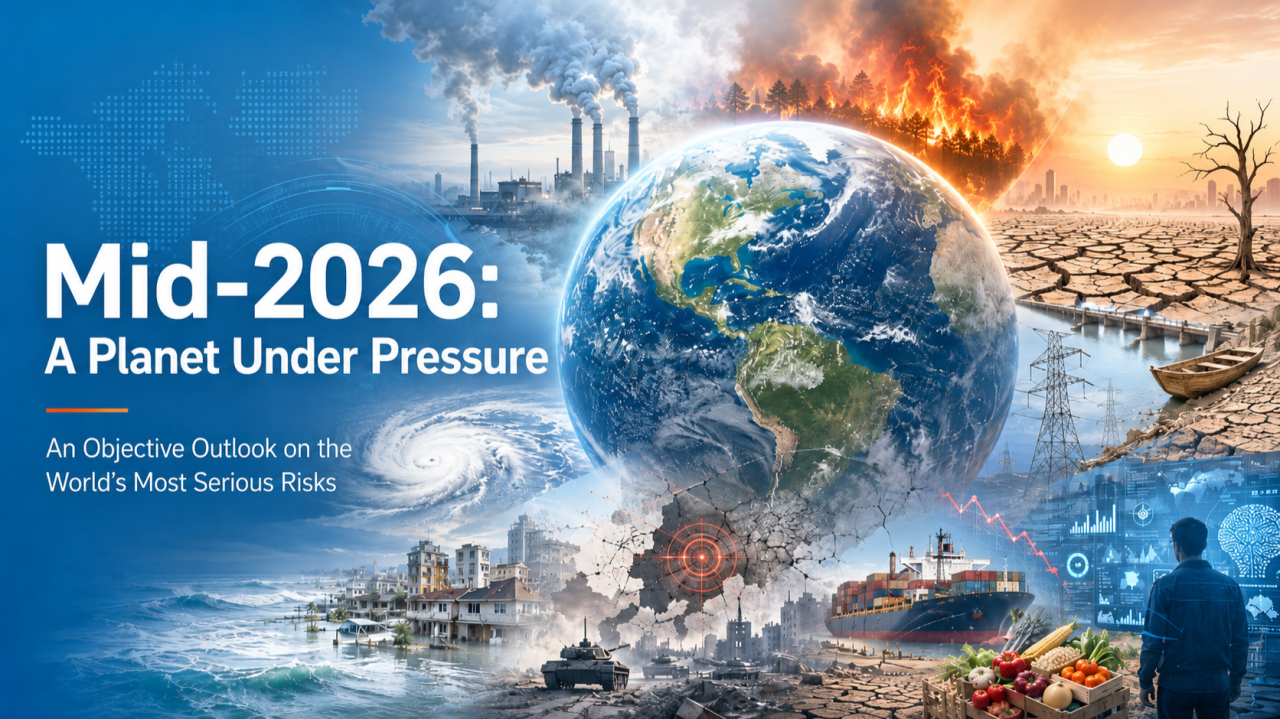
As we reach the middle of 2026, an objective outlook on the planet’s most serious risks seems not only necessary, but urgent.
The world is not facing one single crisis. It is facing a convergence of pressures: climate instability, water scarcity, ecosystem degradation, geopolitical conflict, food insecurity, technological disruption, inequality, misinformation, and weakening governance systems. Each of these risks is serious on its own. Together, they are reshaping the operating conditions for societies, governments, industries, investors, and communities.
The central challenge of our time is no longer whether humanity understands the risks. In most cases, we do. The challenge is whether our institutions, infrastructure, economic models, and political systems can adapt fast enough to prevent these risks from becoming permanent structural failures.
Climate Change Is No Longer a Future Scenario
Climate change is now a present operating condition. Heatwaves, droughts, floods, storms, wildfires, and shifting rainfall patterns are affecting every region of the planet in different ways.
The most concerning aspect is not only the rise in temperatures, but the instability it creates. Climate change affects water availability, agricultural productivity, public health, insurance markets, infrastructure design, energy demand, migration patterns, and social stability.
What once appeared as an environmental issue is now a macroeconomic and security issue. Every business, city, utility, and public institution must now ask a different question: not only how to reduce emissions, but how to remain operational in a more volatile climate.
Water Scarcity Is Becoming a Defining Global Risk
Water is emerging as one of the most strategic resources of the twenty-first century. The problem is not limited to regions traditionally associated with drought. Water stress is expanding across cities, agricultural areas, industrial zones, energy corridors, tourism hubs, and technology infrastructure.
The global water crisis has many faces: drought, aquifer depletion, polluted rivers, aging distribution systems, insufficient storage, saltwater intrusion, flooding, poor wastewater treatment, and competition between human consumption, agriculture, industry, energy generation, and data centers.
The most dangerous misconception is that water risk is only about “running out of water.” In reality, water risk is about reliability, quality, affordability, access, governance, and resilience. A region may have water on paper and still lack the infrastructure to deliver it safely and consistently.
This is why water independence and decentralized water resilience are becoming essential. The future will require local production, reuse, storage, treatment, monitoring, and intelligent integration with energy systems.
Biodiversity Loss Is Weakening the Planet’s Natural Infrastructure
Nature is not decoration. It is infrastructure.
Forests regulate rainfall and temperature. Wetlands absorb floods and filter water. Soils support food production. Oceans regulate climate. Pollinators sustain agriculture. Biodiversity provides resilience against disease, climate shocks, and ecosystem collapse.
The loss of biodiversity is therefore not only an ecological tragedy; it is an economic, food security, health, and national security risk. When ecosystems degrade, the services they provide must either be replaced artificially at enormous cost or are lost entirely.
The planet is losing resilience. This means that shocks that were once absorbed naturally are now becoming disasters.
Conflict and Geopolitical Fragmentation Are Disrupting Global Stability
Wars, regional conflicts, trade tensions, cyberattacks, and geopolitical fragmentation are weakening the global cooperation needed to address shared risks.
Conflict destroys lives directly, but it also destabilizes food systems, energy markets, shipping routes, humanitarian operations, and investment planning. It increases inflation, interrupts supply chains, diverts public budgets, and makes long-term infrastructure planning more difficult.
The world is entering a period where resilience can no longer depend on global stability. Countries, companies, and communities must prepare for uncertainty as a baseline condition.
Food Insecurity Is Becoming More Complex
Food insecurity is no longer caused only by poor harvests. It is driven by conflict, climate shocks, water scarcity, fertilizer prices, energy costs, logistics disruptions, economic hardship, and political instability.
Agriculture is one of the sectors most exposed to climate volatility and water stress. At the same time, it is one of the largest users of freshwater. This creates a difficult global dilemma: how to feed a growing population while protecting water systems, restoring soils, reducing emissions, and adapting to extreme weather.
Food security in the coming decade will depend not only on agricultural production, but on integrated water management, energy reliability, resilient logistics, and ecosystem restoration.
Inequality Is Reducing the World’s Ability to Adapt
Inequality is a risk multiplier. Communities with fewer resources are less able to prepare for climate shocks, water shortages, health emergencies, food price increases, or technological disruption.
When inequality rises, trust declines. Social cohesion weakens. Political polarization grows. Public institutions lose legitimacy. This makes it harder to implement long-term solutions, even when those solutions are technically available.
A world of high risk requires strong social resilience. Without fairness, access, and inclusion, adaptation itself becomes unstable.
Public Health Risks Remain Global and Systemic
The pandemic showed that public health is deeply connected to mobility, trade, labor, education, finance, governance, and trust. Future health risks remain serious, including pandemics, antimicrobial resistance, heat-related illness, poor air quality, waterborne disease, and the health consequences of displacement and food insecurity.
Climate change will intensify many of these risks. Extreme heat affects the elderly, children, workers, and people with pre-existing conditions. Flooding can contaminate water systems. Drought can reduce sanitation and increase disease exposure. Air pollution and wildfires affect respiratory health. Health resilience must now be understood as part of infrastructure resilience.
Misinformation and Polarization Are Weakening Collective Action
No society can solve complex problems if it cannot agree on facts.
Misinformation affects climate policy, public health, elections, financial markets, emergency response, and social trust. It slows decision-making, creates confusion, and turns technical problems into ideological battles.
This is one of the least visible but most dangerous global risks. The planet may have the technology to solve many of its problems, but without trust, coordination, and credible information, solutions are delayed or rejected.
Artificial Intelligence Is Both a Solution and a New Systemic Risk
Artificial intelligence may help accelerate scientific discovery, optimize energy systems, improve water management, strengthen health diagnostics, and support climate modeling. But it also creates new risks.
AI can amplify misinformation, increase cyber threats, disrupt labor markets, concentrate power, enable surveillance, and intensify demand for energy, water, land, and critical minerals.
The data center boom linked to AI is already creating pressure on electricity grids, water systems, communities, and permitting processes. This does not mean AI should be rejected. It means AI infrastructure must be designed responsibly from the beginning. AI cannot be considered sustainable if the infrastructure behind it increases pressure on already stressed energy and water systems.
Weak Governance May Be the Most Dangerous Risk of All
The world’s biggest problems are interconnected, but our institutions often remain fragmented.
Climate policy is separated from water policy. Energy planning is separated from land use. Infrastructure finance is separated from community impact. Technology development is separated from environmental limits. National interests often override global cooperation.
This fragmentation is one of the deepest risks facing the planet. The pace of change is accelerating, but many governance systems are still designed for slower, more predictable conditions.
The Common Thread: Infrastructure Resilience
Across all these risks, one theme becomes clear: resilience is no longer optional.
The world needs resilient infrastructure that can operate under climate stress, water scarcity, energy volatility, supply chain disruption, social pressure, and regulatory uncertainty. This includes decentralized energy, water production, water reuse, storage, smart monitoring, circular systems, and service-based models that reduce upfront barriers to implementation.
The next generation of infrastructure cannot be built as isolated assets. Water, energy, food, technology, health, and community resilience must be designed together.
A hospital without reliable power is not resilient. A city without water security is not resilient. A data center without a credible water and energy strategy is not resilient.
A Necessary Shift
The planet’s most serious risks are not warning signs anymore. They are operating realities. But this does not mean the future is hopeless. It means the future must be built differently.
The world does not only need more infrastructure. It needs better infrastructure: decentralized, adaptive, low-impact, financeable, locally relevant, and capable of protecting both people and natural systems.
The middle of 2026 should be remembered as a moment of clarity. The risks are visible. The science is available. The technologies exist. The capital exists. The need is undeniable.
What is missing is speed, coordination, and the courage to move from short-term reaction to long-term resilience. A planet under pressure cannot be sustained by fragile systems. It must be supported by resilient ones.