Follow-up to: "Can there really be Global Water Cooperation in today’s geopolitics?"
In our earlier exploration of whether global water cooperation could withstand the pressures of modern geopolitics, we concluded that cooperation is possible, but fragile — and constantly tested by climate change, shifting priorities, and security concerns.
Now we have a very concrete example of that test in motion.
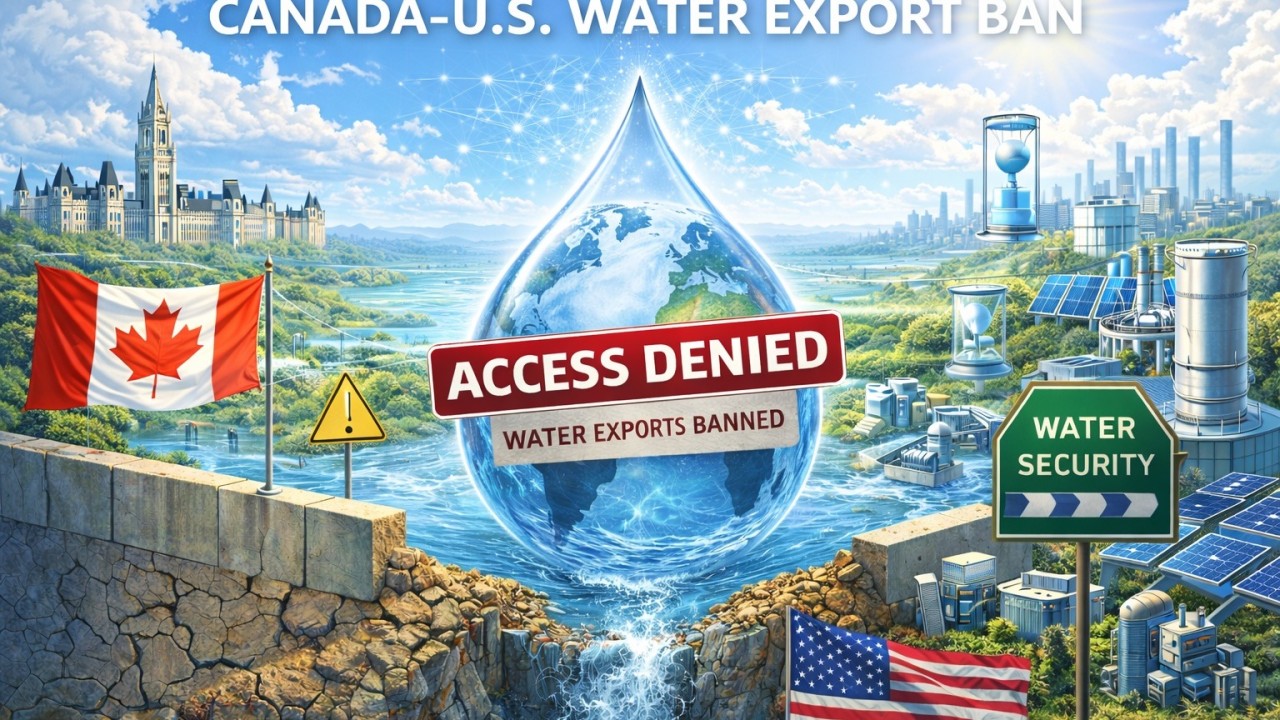
A recent report describes a development that underscores the point: a major Canadian freshwater basin that supplies drinking water to roughly 40 million people and supports an estimated $890 billion in economic activity is now under a complete ban on water exports to the United States.
This isn’t an abstract policy nuance. It is a sovereign decision with real economic, political, and governance implications — and it illustrates a new era in transboundary water relations.
When Sovereignty Trumps Shared Governance
For decades, Canada and the U.S. have maintained complex but largely cooperative institutions for managing shared waters — from the Great Lakes to numerous river basins — with the Boundary Waters Treaty of 1909 and the International Joint Commission (IJC) as enduring cornerstones.
But today, water policy is intersecting with economic sovereignty and national resource strategy in ways that were unimaginable in 1909.
A full export ban — even one framed as protective or conservation-oriented — signals that water can be legislated as a strategic national asset when political winds shift. And when one partner asserts sovereign control in new ways, even long-standing cooperation frameworks must adapt rapidly or risk becoming obsolete.
"Cooperation alone is no longer sufficient — resilience, adaptation, and diversified governance are now equally critical."
Why This Matters
- Water is no longer only a shared environmental resource. It is policy leverage, economic capital, and a strategic asset tied to national identity and economic security.
- Even stable partners can pivot. A sovereign export ban between Canada and the U.S. — countries with some of the most robust transboundary water institutions — shows that political priorities can override centuries-old norms when water enters the economic or security domain.
- Treaties designed for a different era may lag behind new realities. Many international water agreements — including those in North America — were created when industrial growth and treaty stability were assured. They were not designed for policy decisions driven by economic blocs, sovereign resource strategy, or water as a traded commodity.
This has profound implications for global water governance, especially in regions where shared basins already face climate extremes, demographic stress, and geopolitical fragmentation.
The Strategic Response: Resilience Through Diversification
If geopolitics can alter the terms of cooperation — even between long-aligned partners — then water strategy must do more than negotiate treaties.
Water governance must evolve into resilient, decentralized systems that can operate independently of singular source pressures.
That’s where models such as Water-as-a-Service (WaaS) and decentralized, climate-resilient water infrastructure offer strategic value:
- Diversify water supply sources Decentralized systems — atmospheric water generation, brackish desalination, reuse loops — reduce dependency on any one river basin or geopolitical counterpart.
- Increase local resilience to disruption When local communities and cities have autonomous, scalable water solutions, they are less vulnerable to cross-border policy shifts or supply restrictions.
- Decouple water from geopolitical constraints Technology-enabled water services make it harder for water policy to be wielded as leverage — water security becomes distributed, less monopolized, and more agile.
"Water cooperation is necessary. But resilience — technical, institutional, economic — is what sustains water security in an unstable world."
A Call to Action: From Governance to Strategic Resilience
The Canada–U.S. export ban episode is a wake-up call:
- Governments and multilateral institutions must refresh water governance models to include economic, security, and sovereignty dimensions.
- Cities and regions must invest in distributed water solutions as insurance against geopolitical volatility.
- Investors and infrastructure planners must treat water infrastructure as strategic resilience assets, not just utilities.
The future of water security will not be won by treaties alone, but by innovation, diversification, and resilience at every level — from basins to neighborhoods.
Water is still a shared resource — but in the 21st century, it must also be a shared strategy.