Why Digital Infrastructure Must Become Water-Resilient Infrastructure
The digital economy runs on invisible systems. Cloud computing, artificial intelligence, fintech, defense networks, and smart cities all depend on data centers operating continuously. As AI accelerates, the conversation has focused primarily on energy demand.
But there is another constraint emerging — water.
Modern hyperscale and AI-intensive data centers consume significant volumes of water, largely for cooling. A single large facility can require millions of liters per day depending on climate conditions, cooling architecture, and computational density. As GPU clusters expand and AI moves from research to full deployment, water intensity is structurally increasing.
What makes this more complex is geography. Many data center clusters are growing in regions already facing water stress — Northern Mexico, the U.S. Southwest, Chile, parts of Europe, and the Middle East. These are areas where aquifers are declining, drought cycles are intensifying, and industrial demand is rising due to nearshoring and manufacturing expansion.
Water is no longer a secondary utility input. It is becoming a strategic variable.
For operators and investors, this creates layered risk: physical (drought and supply disruption), regulatory (permitting friction and water concessions), reputational (community opposition), and financial (asset valuation and insurance exposure). As AI becomes critical infrastructure, water resilience must become part of infrastructure design — not an afterthought.
Rethinking the Traditional Model
The traditional model assumes stable municipal supply, evaporative cooling, and centralized energy dependence. That model was designed for a different era — one with more predictable hydrology.
The next generation of data centers must evolve.
Cooling systems can shift toward low-evaporation architectures and closed-loop designs. Facilities can integrate reclaimed and non-potable water streams. Water Usage Effectiveness (WUE) should be measured with the same rigor as PUE. But incremental efficiency alone may not be sufficient in structurally water-constrained regions.
A more resilient approach requires rethinking infrastructure as integrated water-energy systems.
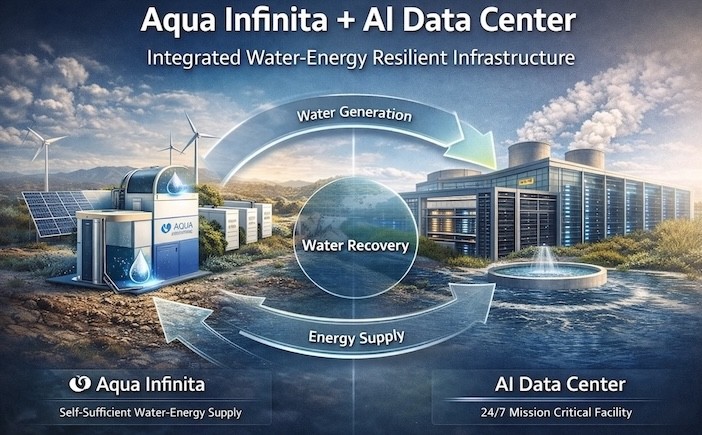
Imagine data centers that are not fully dependent on stressed aquifers. Facilities that can supplement supply through on-site atmospheric water generation, powered by self-sufficient renewable energy systems. Hybrid models where water recovery, energy storage, and intelligent management platforms operate together to stabilize both water and power inputs. This shifts the paradigm from water consumption to water strategy.
The Nearshoring Convergence in Mexico
In regions like Mexico — where nearshoring, industrial growth, and digital infrastructure expansion are converging — the ability to align energy independence with water resilience will determine long-term competitiveness.
Infrastructure that secures its own water supply reduces regulatory friction, protects community relationships, and strengthens operational continuity.
The Aqua Infinita Solution
This is the strategic logic behind integrated platforms such as AquaInfinita by EAWD®️ — a self-sufficient water-energy supply framework designed to complement existing infrastructure by generating water from the atmosphere using renewable-powered systems.
Rather than replacing municipal sources, such models provide resilience layers, reduce pressure on aquifers, and create operational buffers for high-demand facilities like AI data centers. In water-stressed geographies, this kind of decentralized, scalable solution can transform water from a vulnerability into a managed asset.
Conclusion
Digital infrastructure is becoming critical national infrastructure. It must therefore be designed with the same systemic resilience as energy grids and water utilities.
The AI economy will not be limited by processing power alone. It will be shaped by how intelligently we manage the water-energy nexus.
The future of data centers is not only about efficiency. It is about self-sufficiency, resilience, and integrated design.
Those who solve the water equation will lead the next phase of digital expansion.