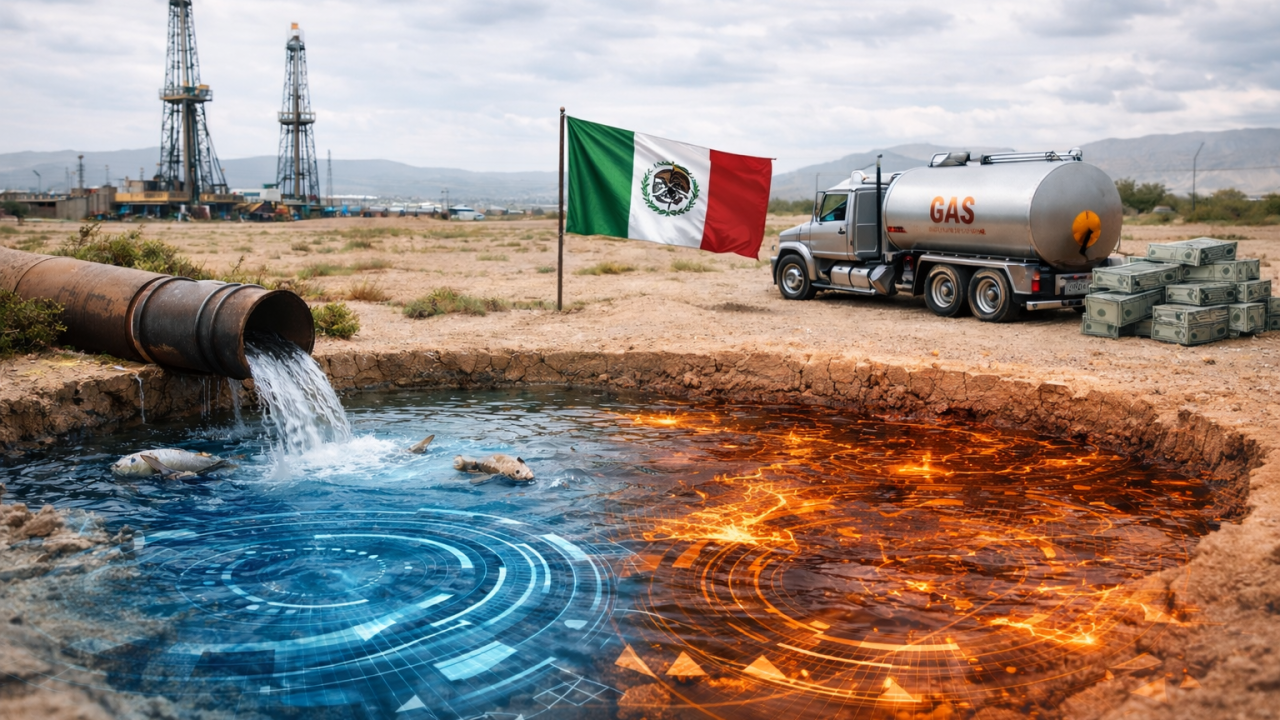
A Strategic Debate Between Energy, Water, and Geopolitical Security
Mexico faces a complex and increasingly relevant decision: How can the country balance energy development through fracking with growing pressure on water resources?
This is not a simple debate. On one hand, there is the need to strengthen the country’s energy security. On the other, water availability has become one of Mexico’s most significant structural challenges.
But there is a third factor gaining importance: Energy geopolitical security.
More than a discussion for or against fracking, the real challenge is how to manage energy, water, and geopolitical risks in a balanced way.
Mexico’s Energy Reality
Mexico relies heavily on natural gas, particularly for:
- Electricity generation
- Industry
- Manufacturing
- Nearshoring
Today, more than 60% of Mexico’s electricity depends on natural gas. But there is an even more relevant factor: Mexico imports approximately 70–75% of its natural gas from the United States.
This creates a new type of vulnerability: External energy dependence, exposure to trade tensions, regulatory or political risks, supply disruptions, and price volatility.
Although the energy relationship between Mexico and the United States has historically been stable, recent history shows that geopolitical factors can change quickly. Recent global examples include Europe’s energy crisis due to dependence on Russian gas, supply disruptions caused by regional conflicts, and regulatory changes impacting energy exports.
These events have led many countries to rethink their national energy security. In this context, the development of domestic resources, such as unconventional gas, is once again entering the conversation.
What is Fracking?
Fracking (hydraulic fracturing) is a technique used to extract natural gas and oil from deep formations. The process involves deep drilling, high-pressure water injection, the use of sand and additives, and the release of trapped gas.
Depending on the field and geology:
- Each well may require between 9 and 29 million liters of water.
- Wastewater is generated and must be treated.
- Activity may extend over several years.
This introduces the water component into the discussion.
Mexico’s Water Reality
Mexico faces significant water challenges, including more than 60% of the territory under water stress, more frequent droughts, overexploited aquifers, aging infrastructure, and accelerated industrial growth.
Additionally, some regions with fracking potential overlap with areas under water pressure, such as Coahuila, Nuevo León, Tamaulipas, Chihuahua, and Veracruz. This makes careful regional planning essential.
The Balance Between Water, Energy, and Geopolitics
The fracking debate in Mexico is no longer only technical or environmental. It is a national strategic debate involving:
- 1. Energy Security: Reducing external dependence.
- 2. Water Security: Protecting critical resources.
- 3. Geopolitical Security: Reducing international vulnerability.
These decisions require a long-term vision.
International Experience
Many countries have faced similar dilemmas. The United States developed its shale gas industry to reduce energy dependence. Europe is seeking to diversify energy sources following recent crises. Asian countries are investing in domestic energy security.
Each country has found its own balance. Mexico could do the same.
An Opportunity for Innovation
This context also opens opportunities for industrial water reuse, water efficiency technologies, water-energy integration, resilient infrastructure, and decentralized solutions.
"The goal is not to choose between water or gas. It is to develop both responsibly and sustainably."
Conclusion
Fracking in Mexico represents an energy opportunity, a water challenge, and a geopolitical factor.
The country faces a strategic decision: How to reduce energy dependence without compromising water security?
The answer will likely not be a single solution, but a combination of regional planning, technological innovation, clear regulation, and a national energy strategy. Mexico has the opportunity to design a balanced model that strengthens its energy, water, and geopolitical resilience.
Because in the future, the security of nations will not depend only on energy… It will also depend on water.